
Low Loss DC Circuit Protection for High Voltage Power Systems.
Enable fast, intelligent DC protection without carrying normal operating current through a lossy power semiconductor.
Cenfire is developing a MEMS-based circuit protection platform for next-generation DC power architectures, combining metallic low loss conduction, integrated current sensing, and active galvanic isolation.
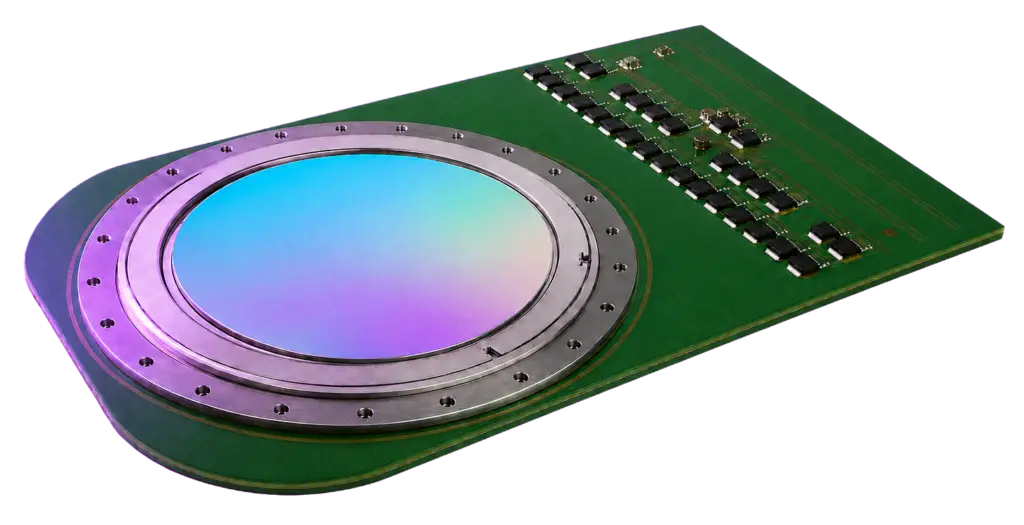
Conduct through a metallic MEMS path instead of a continuously dissipating semiconductor path.
Use integrated sensing and active MEMS actuation to support microsecond-level protection response.
Tile MEMS protection cells from module-level protection toward higher-current DC architectures.
As power systems move toward higher voltage DC distribution, protection requirements are changing. AI data centers, battery systems, industrial automation, and electrified infrastructure need protection that is fast, selective, compact, and efficient.
Traditional mechanical breakers offer low conduction loss, but they are too slow for many high-energy DC fault conditions. Conventional solid-state breakers act quickly, but they carry current through power semiconductors during normal operation, creating continuous heat.
Cenfire targets the gap between these two approaches: solid-state speed with a metallic low loss conduction path.

DC faults do not naturally self-extinguish. Unlike AC systems, there is no zero crossing to help stop current flow. As voltage, current, and stored energy increase, protection devices must clear faults quickly while managing arc energy, thermal load, and post-fault isolation.
High voltage DC protection requires:

Cenfire’s MEMS platform is being developed to address these requirements through a hybrid protection architecture.
Cenfire’s DC protection concept separates the key breaker functions instead of forcing one device to do everything.
Current flows through a parallel metallic MEMS conduction array to reduce steady-state power loss.
Integrated current sensing and programmable trip logic monitor the load and detect overcurrent conditions.
Dedicated arc-tolerant contacts, micro arc management structures, and optional semiconductor commutation paths help manage hot-switching events.
After clearing, the MEMS contact opens into a true galvanic isolation state
At high current, even small conduction losses become a thermal problem. Cenfire’s MEMS architecture is designed to reduce continuous breaker loss by moving normal operating current through metallic contacts.
Lower conduction loss makes it practical to place protection closer to the load, including rack inputs, power shelves, converter modules, battery segments, and service disconnect points.
Fast, selective DC protection can isolate local failures before they propagate across the power architecture.
By targeting low hundreds of watts instead of kilowatt-class breaker heat, Cenfire can support simpler thermal paths and reduce dependence on liquid-cooled switchgear.
Cenfire’s MEMS platform can be tiled from module-level current protection toward larger parallel arrays for higher-current systems.
Low loss protection for next-generation high voltage DC power distribution in AI infrastructure.
Fast isolation at the rack or sidecar power input without adding kilowatt-class breaker losses.
Low loss switching and protection for automation, robotics, motor control, and high-power industrial equipment.
Distributed protection for 800 VDC power shelves, bus segments, and conversion stages.
Compact protection at the input of high-voltage converter modules.
Fast disconnect and galvanic isolation for energy storage, backup power, and intermediate DC storage nodes.

Cenfire is developing the platform around the requirements of high voltage DC power systems.
| Requirement | Cenfire Direction |
|---|---|
| Voltage class | Targeting 800 VDC to 1000 VDC architectures |
| Current scaling | Parallel MEMS arrays from module to rack-level protection |
| Conduction path | Metallic MEMS contacts |
| Fault detection | Integrated current sensing and programmable trip logic |
| Interruption architecture | Hybrid MEMS, arc management, and optional commutation |
| Isolation | True galvanic isolation after clearing |
| Thermal goal | Lower breaker heat than conventional solid-state protection |
| Integration | Module, busbar, rack, and power shelf architectures |
Conventional solid-state breakers solve speed by keeping a semiconductor in the current path at all times. That creates continuous conduction loss.
Cenfire’s approach is different.
The normal current path is metallic. The active protection system is used when needed. This allows Cenfire to target fast DC protection without paying the continuous semiconductor loss penalty during normal operation.
Start with lower-current protection points such as converter inputs, battery segments, and service disconnects.
Scale parallel MEMS arrays into higher-current DC protection modules.
Use wafer-scale MEMS tiling to target kiloamp-class protection with low conduction loss.
Evaluate voltage, current, trip time, isolation, and thermal requirements for your DC protection node.
Explore distributed protection strategies that reduce fault propagation and improve serviceability.
Assess the cost of breaker loss, switchgear cooling, infrastructure complexity, and deployable power.